
Light refreshment, general restaurant or food factory: which Hong Kong food licence do you need?
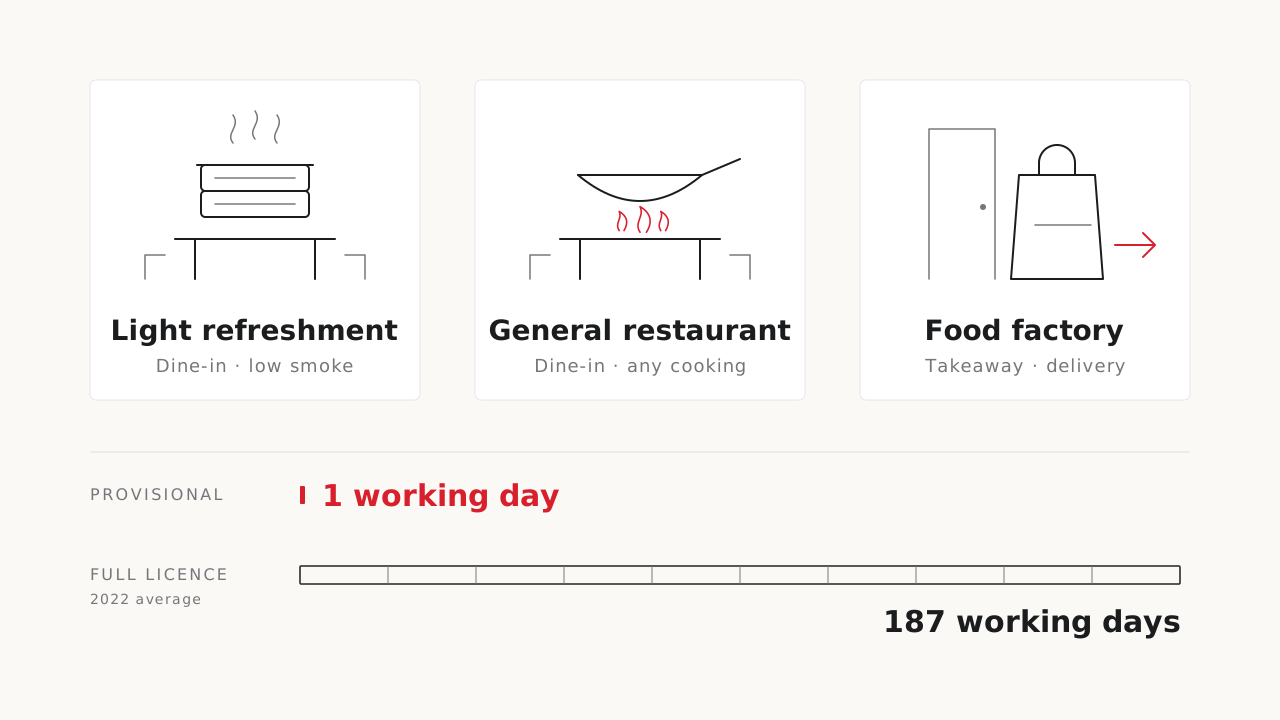
Two questions decide it: where do customers eat, and how do you cook. Eaten on the premises with only boiling, stewing, steaming, braising or simple frying: light refreshment restaurant licence. Eaten on the premises with deep frying or stir frying: general restaurant licence. Takeaway, delivery or a ghost kitchen: food factory licence.
A provisional licence can be issued in 1 working day once the essential health, building and fire requirements are met. But the Audit Commission measured an average of 187 working days for a new full restaurant licence in 2022. Government grant fees for premises up to 100 m² are $400 to $2,330 a year, and are waived until 31 October 2026.
TCSP licence TC010617 · Updated October 2026
Pick the wrong licence and the usual cost is not a fine, it is a second fit-out. This post covers three things: which licence, how long, and what the government charges.
Which food licence should I apply for?
Two questions decide it: where do customers eat, and how do you cook.
If customers eat on the premises, you need a restaurant licence. If they take the food away or it is delivered, you need a food factory licence. Among restaurant licences, low-fume cooking only qualifies for a light refreshment restaurant licence; deep frying or stir frying needs a general restaurant licence.
All three are issued by the Food and Environmental Hygiene Department (FEHD) under the Public Health and Municipal Services Ordinance (Cap. 132) and the Food Business Regulation (Cap. 132X).
| Licence | How you can cook | Where customers eat | Government fee (≤100 m², grant / renewal, per year) | Typical use |
|---|---|---|---|---|
| Light refreshment restaurant | Boil, stew, steam, braise, simple fry only; no deep or stir frying | On premises | $400 / $1,810 | Café, light eatery |
| General restaurant | Any cooking method | On premises | $1,110 / $2,520 | Full-service restaurant |
| Food factory | No special restriction on cooking method | Off premises: takeaway, delivery, wholesale, catering | $2,330 / $3,740 | Takeaway shop, bubble tea, two-dish rice, ghost kitchen |
These are FEHD fees per its fee schedules as at November 2025, not our service fee.
The points people most often get wrong:
- There is no ghost-kitchen licence. Delivery-only with no dine-in uses the food factory licence.
- A food factory licence does not allow dine-in. The FEHD line is clear: food for consumption off the premises needs a food factory licence; on the premises needs a restaurant licence.
- A home kitchen cannot be licensed. Hong Kong has no home-cooking licence; the FEHD requires licensed premises.
- Selling alcohol is a separate licence. A liquor licence is issued by the Liquor Licensing Board under the Dutiable Commodities Ordinance (Cap. 109) and applied for separately — see Hong Kong liquor licence. Every licensed premises also needs a fire-service inspection every 12 months: annual fire inspection (FS251).
What can a light refreshment restaurant cook now?
Since 1 March 2023, the light refreshment restaurant licence is regulated by cooking method, not by a list of foods.
Permitted methods are simple and low-fume: boiling, stewing, steaming, braising and simple frying. Deep frying and stir frying are excluded. So the question is not “may I sell this dish” but “how will I cook it”.
The FEHD Annual Report 2023 says that by the end of 2023, over 580 licensed or newly licensed light refreshment restaurants had benefited from the relaxation.
Sources that still explain the licence through an approved food list are describing the rules before March 2023.
One more point: baking in a light refreshment restaurant with an oven under a fume hood counts as a heavier-fume method and needs a separate bakery licence.
What else do I need besides the main licence?
Some foods need an extra permit or endorsement, whichever main licence you hold:
| You want to sell | You also need |
|---|---|
| Non-bottled drinks, including bubble tea | Restricted food permit for non-bottled drinks (unless covered by a composite permit) |
| Sashimi, sushi, raw oysters | Restricted food permit; for restaurants, an endorsement |
| Soft ice cream from a machine | Frozen confection factory licence |
| Siu mei or lo mei made on site | Food factory licence (reselling bought-in siu mei needs a siu mei and lo mei shop licence) |
A composite restricted foods permit has been available as an option since 1 January 2025.
How long does a food licence take?
A provisional licence can take 1 working day. A full licence takes months in practice.
Provisional licence. Once the premises meet all essential health, building and fire-safety requirements, a provisional licence can be issued over the counter within 1 working day, valid for 6 months. The licensee must complete the remaining requirements in that time to convert to a full licence.
Note that the 1 working day counts from when the essentials are met, not from the day you file. The plans, fit-out and departmental referrals before that are where the time goes.
Full licence. The FEHD’s pledges are:
- An Application Vetting Panel meeting within 20 working days of accepting the application, including referral time.
- After the applicant meets the licensing conditions, a verification inspection within 8 working days; if compliant, the full licence within 7 working days.
- Under the Professional Certification Scheme (“licence first, audit later”), the final step shortens to 2 working days. It has applied to light refreshment restaurants and food factories since 1 March 2023; the 2023 Policy Address said it would extend to general restaurants from Q1 2024.
Those are targets, not results. In Report No. 81 (October 2023) the Audit Commission recalculated the 2022 average processing time for a new full restaurant licence at 187 working days; the FEHD had reported 173. Averages across licence types ranged from 138 to 217 working days.
| Provisional | Full | |
|---|---|---|
| Condition | Essential health, building, fire requirements met | All licensing conditions met |
| Issue time (target) | Over the counter, 1 working day | 7 working days after a compliant inspection; 2 under the Professional Certification Scheme |
| Measured average (2022) | — | 187 working days (Audit Commission) |
| Validity | 6 months | Annual renewal |
One more rule: since 2006, a former provisional licence holder cannot re-apply for a provisional licence for the same business at the same premises within 3 years of the previous one expiring.
What are the government fees, and how long is left on the waiver?
For premises up to 100 m², the FEHD charges per year (fee schedules, November 2025):
| Licence | Grant | Renewal | Provisional (half of renewal) |
|---|---|---|---|
| Light refreshment restaurant | $400 | $1,810 | $905 |
| General restaurant | $1,110 | $2,520 | $1,260 |
| Food factory | $2,330 | $3,740 | $1,870 |
After the Fire Services (Registered Fire Engineers) Regulation (Cap. 95H) took effect on 1 November 2025, new-licence grant fees no longer include the Fire Services Department’s prescribed fees, which is why grant fees are lower than renewal fees.
The waiver is ending. The FEHD announced on 10 October 2025 that grant and renewal fees are waived for food business licences effective from 1 November 2025 to 31 October 2026, with prepaid fees refunded. As at 11 October 2026, that leaves 20 days.
Given the processing times above, a licence applied for today will most likely not take effect before 31 October. Budget for the fee. Any extension depends on a government announcement.
The licence fee is the small number. The real costs sit here, and none has a government fee schedule:
- Authorised Person or registered structural engineer drawings and certification.
- Fire service installation works and the FS251 certificate; ventilation works and certificate.
- Exhaust ducting to roof level and a grease trap.
- Registered Fire Engineer fees, which the Security Bureau says are set by market supply and demand.
- Lands Department waiver fees, assessed on the added value of the relaxed use.
Where do applications usually get stuck?
Rarely on the FEHD fee. Usually in referrals to other departments and in repeated plan revisions.
From the Audit Commission’s sample:
- 35 of 89 first departmental referrals (39%) exceeded the 3-working-day target.
- Applicants in 50 cases revised their layout plans 569 times in total, 3 to 37 times each, 11 on average.
- 11% of revised-plan reviews missed their deadline, with delays of up to 173 working days.
| Department | Checks | Common sticking point |
|---|---|---|
| Buildings Department | Building safety, minor works, unauthorised works | Unauthorised building works must be removed first |
| Fire Services Department | FS251, fire installations, ventilation | Certificates not complete |
| Lands Department | Lease use restrictions | Needs a waiver or lease modification |
| Environmental Protection Department | Oily fumes and odour | Exhaust not to roof, visible fumes |
| Planning Department | Statutory plans | Wrong zoning |
| FEHD | Hygiene, layout, kitchen area | Repeated plan revisions, missed vetting meetings |
The three hardest blocks:
Unauthorised building works. Any addition or alteration made without Buildings Department approval, and outside the minor works simplified procedure, is unauthorised. The FEHD requires confirmation that the premises have none; if there are any, they must be removed first.
The lease. Government leases on private land often restrict use, for example offensive-trade clauses or industrial-only use. If you plan a two-dish-rice takeaway in an industrial building, read the lease first. If food use is not permitted, you need a waiver or lease modification from the Lands Department.
Oily fumes. Under the Air Pollution Control Ordinance (Cap. 311), premises must not emit visible cooking fumes or objectionable odour. Where diesel or solid fuel is used, the chimney should point vertically upward and preferably extend at least 3 metres above the highest point of the building. A first conviction carries a fine of up to $100,000; a subsequent one $200,000 and 6 months’ imprisonment. The EPD brought 22, 13 and 12 oily-fume or odour prosecutions in 2023, 2024 and 2025.
What should I check before renting a shop?
Check first, sign second. Four things:
- The lease. Get a copy through the Land Registry’s online search service or customer centre and check for use restrictions.
- Unauthorised works. Compare the Buildings Department’s approved plans and minor works records with the actual premises.
- Ventilation. The FEHD advises choosing premises that can give the kitchen, toilets and seating area an independent ventilation system.
- Past licences. The FEHD “Lists of Licensed / Permitted Premises” can be searched by shop sign, address or licence type. It shows only the current holder, address and licence type, not the expiry date or floor area.
Which part can we handle?
We handle all eleven types of FEHD food licence, including the three above. From site assessment, design and renovation to the licence application and final inspection, one person follows your case throughout. An express site visit can be arranged within one day.
Fees on enquiry. See our food licence service. To apply in a company’s name you need a company first: see Hong Kong company registration.
If you have a shop address, or have already received licensing conditions, contact us.
Licence types, government fees, processing times and the fee waiver in this article reflect public information available as at 11 October 2026. Sources: Food and Environmental Hygiene Department (Guide on Types of Licences Required, fee schedules, Annual Report 2023 and press release of 10 October 2025), Audit Commission Report No. 81, Chapter 2 (October 2023), Fire Services Department, Security Bureau, Buildings Department, Lands Department, Environmental Protection Department, and a Legislative Council written reply of 10 June 2026. Government fees are collected by the FEHD and are not our fees. Laws and fees may change; the relevant department’s announcement prevails. This article is general information, not legal advice.