
Annual fire inspection in Hong Kong: every 12 months, who signs FS251, and what happens if it lapses
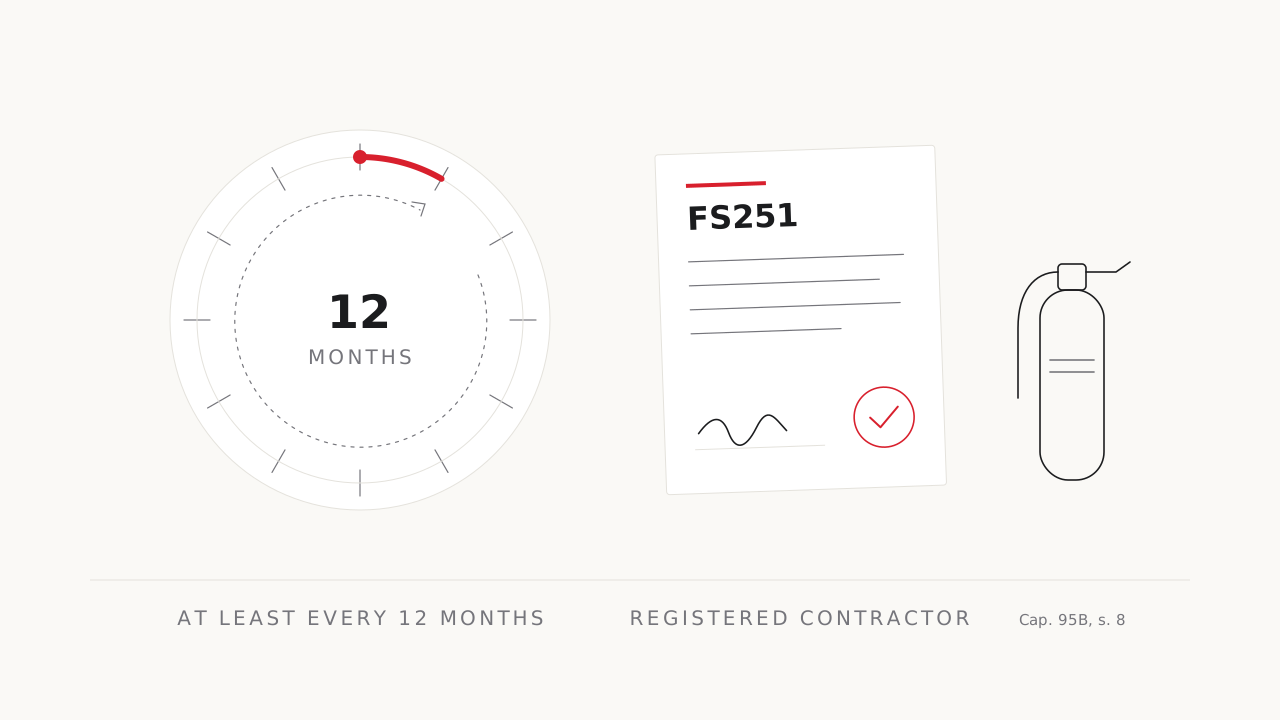
The annual fire inspection is a legal requirement, not an industry habit. Regulation 8 of the Fire Service (Installations and Equipment) Regulation (Cap. 95B) requires the owner of any fire service installation or equipment to have it inspected by a registered fire service installation contractor at least once every 12 months. Breach is an offence liable to a level 5 fine.
The contractor then signs an FS251 certificate. Food-licence applications (provisional and full) and every annual renewal need it. Offices, beauty salons and gyms are covered too.
TCSP licence TC010617 · Updated October 2026
Many people search for an “annual fire inspection company”. The law has no such category. It has one regulation and one certificate.
What is the annual fire inspection, and how often is it required?
It is a statutory inspection required at least once every 12 months. The basis is regulation 8 of the Fire Service (Installations and Equipment) Regulation (Cap. 95B): the owner of any fire service installation or equipment must have it inspected by a registered fire service installation contractor at least once every 12 months.
After the inspection, the contractor signs FS251, the Certificate of Fire Service Installations and Equipment. The “annual fire inspection” is simply that inspection plus that certificate.
Portable equipment runs on a second clock. Extinguishers and other portable equipment also need a hydraulic test every 5 years.
Who has to arrange it? Is it only for restaurants?
The duty sits with the owner of the fire service installations or equipment. It is not limited to restaurants.
The regulation 8 duty follows the installation, not the licence. Any premises with fire service installations or equipment is covered, including offices, beauty salons and gyms. Hong Kong has no dedicated fitness-centre licence, for example, but gyms must still meet fire-safety requirements, including the Cap. 95B annual inspection.
If you are not sure whether the installations in your unit belong to you, the landlord or the building, ask the landlord or the management office. Who arranges the inspection and who pays should be written into the lease before you sign.
Who can carry it out? Is there an “annual fire inspection company” licence?
Only a registered fire service installation contractor. There is no separate licence category for “annual fire inspection companies”.
The Fire Services Department registers contractors in three classes:
| Class | Covers | Typical example |
|---|---|---|
| Class 1 / Class 2 | Inspection and maintenance of fixed fire service installations (excluding portable equipment) | Fixed fire service systems |
| Class 3 | Portable fire service equipment | Extinguishers (plus a 5-yearly hydraulic test) |
So when choosing a contractor, check the registration class, not whether the company calls itself an “annual inspection” firm. Premises with only extinguishers need a different class from premises with fixed systems. Ask for the registration class before asking for a quote.
What is FS251, and where is it used?
FS251 is the Certificate of Fire Service Installations and Equipment, signed by a registered fire service installation contractor.
For any premises, it is the evidence that the regulation 8 inspection has been done. For food premises it has a second use: it is required for the provisional licence, the full licence and every annual renewal. The Fire Services Department runs an online FS251 system; see its website for details.
The FEHB 94 food-licence application form also lists two fire-related certificates you can select: the Fire Safety (Fire Service Installation) Certificate and the Fire Safety (Ventilating System) Certificate. The ventilating-system certificate is a separate document, not FS251.
What happens if the inspection lapses?
Failing to arrange the 12-monthly inspection under regulation 8 is an offence liable to a level 5 fine.
For food premises the cost is more than a fine. FS251 is one of the documents for each annual renewal. If the certificate is out of date, the renewal is one document short. Keep the inspection date and the licence renewal date on the same calendar.
How does the fire inspection tie into a food licence?
At two points: when you apply, and every year when you renew.
When you apply. FEHD refers applications to the Buildings Department, the Fire Services Department, the Planning Department and others. Fire Services looks at fire service installations and ventilation. A provisional licence requires the essential health, building and fire-safety requirements to be met first; it can then be issued over the counter in 1 working day and is valid for 6 months.
Referrals are where time is lost. Audit Commission Report No. 81 (October 2023) found that in 2022 the departmental referral target was 3 working days, yet 39% of first referrals exceeded it, by 1 to 6 days. The average time to process a new full restaurant licence that year was 187 working days. These figures cover all referred departments, not Fire Services alone, but the point holds: if the fire documents are not ready, the whole application waits.
Two changes in 2025. First, the Fire Services (Registered Fire Engineers) Regulation (Cap. 95H) took effect on 1 November 2025. Food business premises applying for a licence can now get the fire-safety risk assessment and certification from a Registered Fire Engineer (RFE); the Fire Services Department’s own service remains available, and RFE fees are set by the market. Second, from the same date, fees for newly issued licences no longer include the Fire Services Department’s prescribed fees; renewal fees are unchanged. Separately, first-issue and renewal fees for food business licences are waived for licences effective 1 November 2025 to 31 October 2026.
These changes affect how you apply for a licence and what it costs. They do not change the 12-monthly inspection duty.
Which licence type you need (light refreshment restaurant, general restaurant or food factory) is covered in which Hong Kong food licence do you need; the liquor licence, a different licence from a different board, is in Hong Kong liquor licence. For the food-licence application itself, see our food licence service.
At a glance: what is inspected, how often, by whom, and the document
| Item | Frequency | Who | Document |
|---|---|---|---|
| Fixed fire service installations | At least every 12 months | Class 1 or 2 registered contractor | FS251 |
| Extinguishers and other portable equipment | At least every 12 months | Class 3 registered contractor | FS251 |
| Hydraulic test of portable equipment | Every 5 years | Class 3 registered contractor | — |
| Food licence application (provisional, full) | On application | Registered contractor signs FS251; fire risk assessment by FSD or an RFE | FS251 and others |
| Food licence renewal | Every year | Registered contractor | FS251 |
What should you prepare before the inspection?
- List every fire service installation and piece of equipment on the premises, split into fixed and portable.
- Confirm whether you, the landlord or the building owns them, and put it in the lease.
- Pick the right contractor class: Class 1 or 2 for fixed installations, Class 3 for portable equipment.
- Check the date of your last FS251 and book the next inspection within 12 months.
- Check each extinguisher’s last hydraulic test; it is due every 5 years.
- For food premises, put the inspection date next to the renewal date, and make sure FS251 is current before you renew.
- For a new restaurant, decide before applying whether the fire risk assessment goes to the Fire Services Department or an RFE.
Questions about opening a restaurant or applying for or renewing a food licence? Contact us.
Laws, deadlines and figures in this article reflect public information as at October 2026, from the Fire Services Department, the Food and Environmental Hygiene Department, the Security Bureau and Audit Commission Report No. 81. Laws and fees may change; the relevant department’s published requirements prevail. This article is general information, not legal advice.